Chasing Stars
Not the Milky Way
After last year’s lack of clear nights in Switzerland, I was determined to get some actual mountain astro shots during our Dolomites stay. Luckily, we did have clear weather for our first few nights here. However, you may have noticed the cover photo for this post is still not the Milky Way. I was once again foiled, but this time it wasn’t the clouds (there’s only 3 real occluding bodies when you’re doing imagery around here, and I am photographing from the surface of one them, so you can probably guess what celestial body washed out the Milky Way).
Thats No Moon (it actually is though)
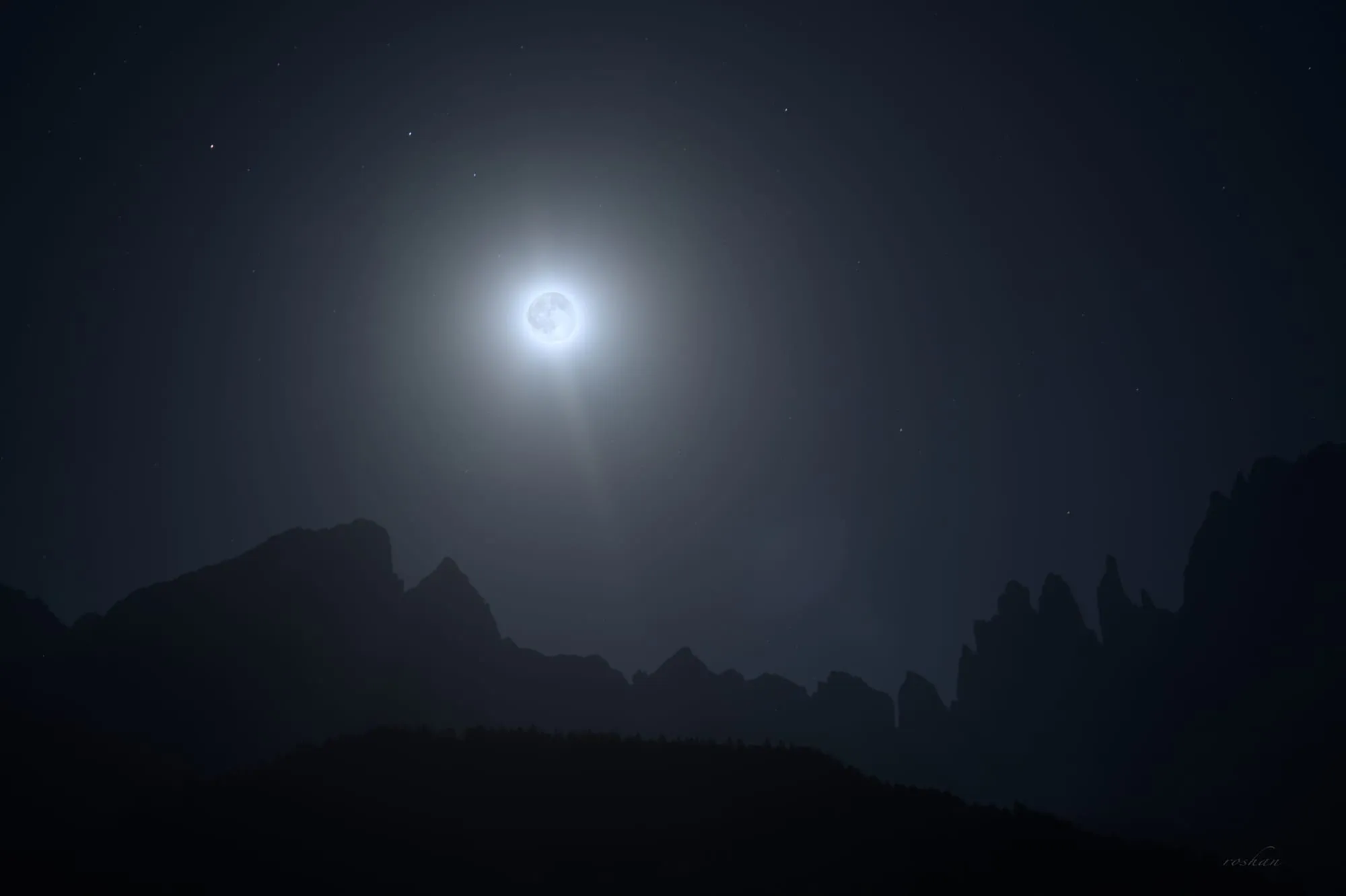
The full moon is just incredibly bright, and moonrise was early, before sunset, and also right where the Milky Way sits this time of year in the northern hemisphere (south-ish). The moon did look really cool, so I decided to try something else I’ve often thought about when looking at a full moon - capturing the actual detail on the surface. My adjustable telephoto lens I use for most things these days goes up to 75mm, so at full zoom (with a really fast shutter speed and manual focus) I was able to get a relatively small moon with some actual surface detailing!
I shot a separate foreground image with a little more exposure (but not too much, because the whole scene gets washed out in a boring way since the light source is right in front of me, rather than behind me), since the foreground is just pitch black from the super short exposure in the moon surface shot. I then literally copy pasted the nice moon surface onto the nice foreground shot (its just a composite image). The sky in the composite image gives a sense of how bright the moon is, and the lighting makes the faces of the mountains dark despite the slightly longer exposure I used on the foreground shot. This was a fun sidequest for me; maybe one day I’ll get a bigger telephoto lens (or a telescope) and do more moon surface photos.
Startrails
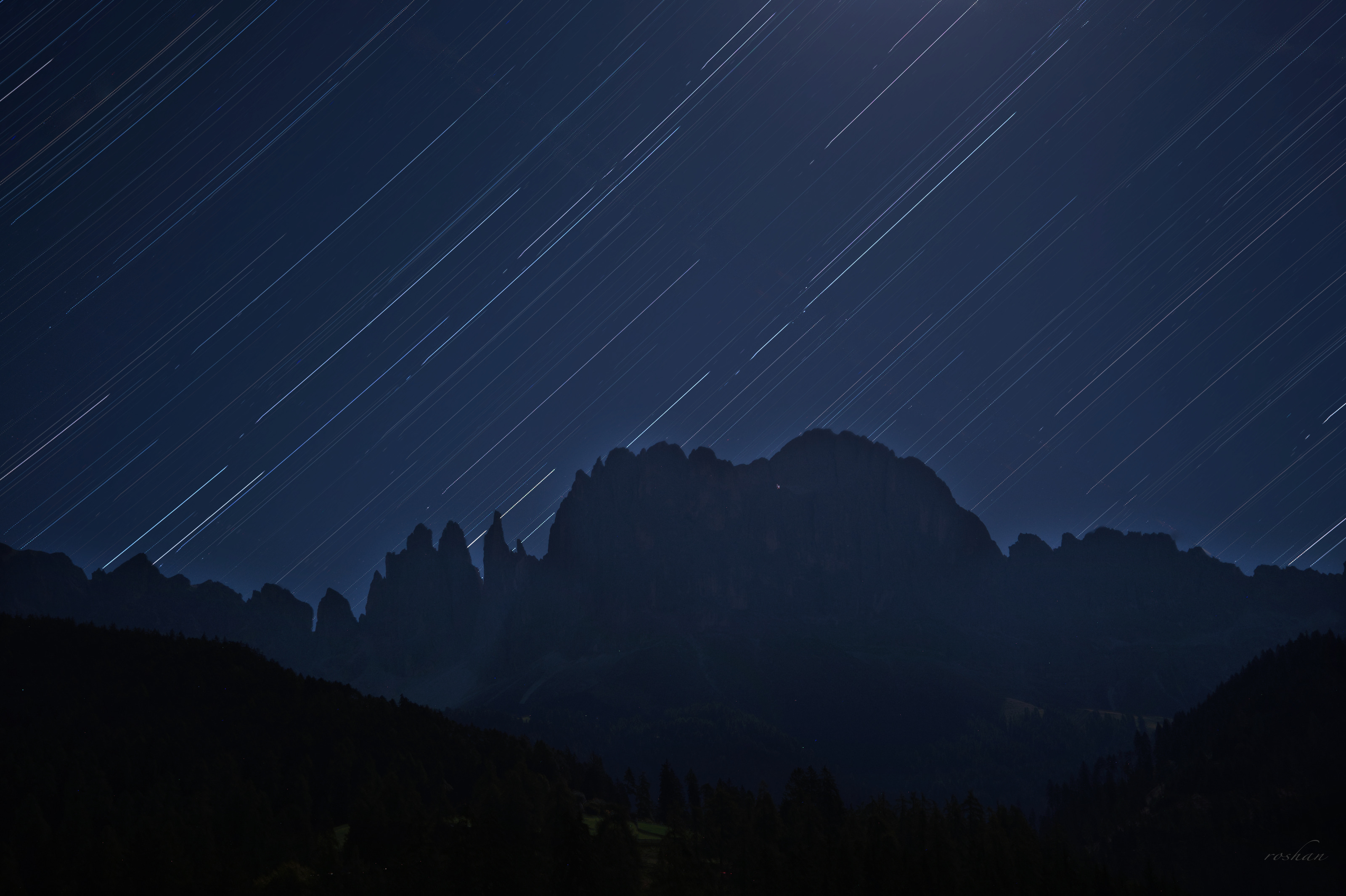
Lunar obfuscation aside, I still wanted to do some kind of long exposure shot that used the Dolomites’ epic beauty as a foreground. I have seen some really epic startrail pictures in the past, and I was considering trying a startrails shot with Matterhorn last summer, so I decided to give it a go while here.
Moon lighting does not inherently ruin startrail photography, but it does make it a bit harder. I had to frame the shot to ensure the moon did not enter the camera’s FOV for the duration of my interval shooting (because it completely washes out any nearby stars). I used a 56mm zoom on my telephoto lens for this one, to keep the moon out of frame, and I did 200 shots at 6sec exposure at low ISO (250) with a relatively open f/4.5. I set my camera to leave roughly 2sec in between shots, and had it on automatic interval shooting mode, so it was basically just capturing images by itself while mounted on my tripod for 40 minutes.
I stacked the resulting 200 images using starstax, which has pretty good tools for sequentially stacking images for startrails specifically (with the added benefit of processing things sequentially, so my laptop did not insta-crash from loading 200 RAWs into RAM like with affinity). After getting a stacked tiff file, I did some affinity edits to make the color balance cooler/more space-y, to remove extraneous streaks from aircraft (lots of planes flying south over northern Italy instead of other parts of Europe for “reasons”), and to make the star trails clearer. Making the trails clearer was interesting: because I had 2second gaps between shots, a lot of the trails looked like dotted lines originally. I added a motion blur that roughly captures the angle of the trails, which smoothed them out (you can still see some gaps if you zoom in). I did a good amount of masking and blending to make this (hopefully) appear pretty seemless. I wanted to get that ephemeral hyperspace-like look of long streaks on a dark blue night sky.
I’m really happy with how this turned out. Having done a couple of Milky Way shots now, it was very cool to do a new type of astrophotography shot this time around. Frankly I was just really hyped to be doing astro again at all, it is so difficult to get opportunities to do this because of the combination of dark skies + clear weather + good foreground required.
The trails themselves came out pretty long, which is what happens when you use a zoom lens (longer apparent angle for a shorter total exposure duration), which is great because I did not have to spend hours taking pictures. In an ideal world, you do this shoot for a full night at a wide angle, and you face north so that you get star trails that form full circles around the north star (because of the Earth’s rotation and our perspective from the ground, the stars all appear to “rotate” around the north star, which appears fixed; this is what made navigation by north star so popular among seafarers in the northern hemisphere historically). I shot this image facing south/southeast, and did it for only 40minutes (as mentioned above) so the stars instead appear to make mostly linear streaks. However, you can see that closer to the north in the photo, the startrails curve a bit more, since the stars are closer to the north star.
I tried to ensure the mountains had a respectable edit by brightening them up a bit while keeping the sky relatively dark blue. I went through a lot of variations on mountain edits and even different foreground composite shots entirely. In the end though, I think this looks cool for what it is. Startrails are a lot of fun, hopefully I’ll get to do more in the future, and hopefully I can come back to the Dolomites during a new moon for some Milky Way action.